
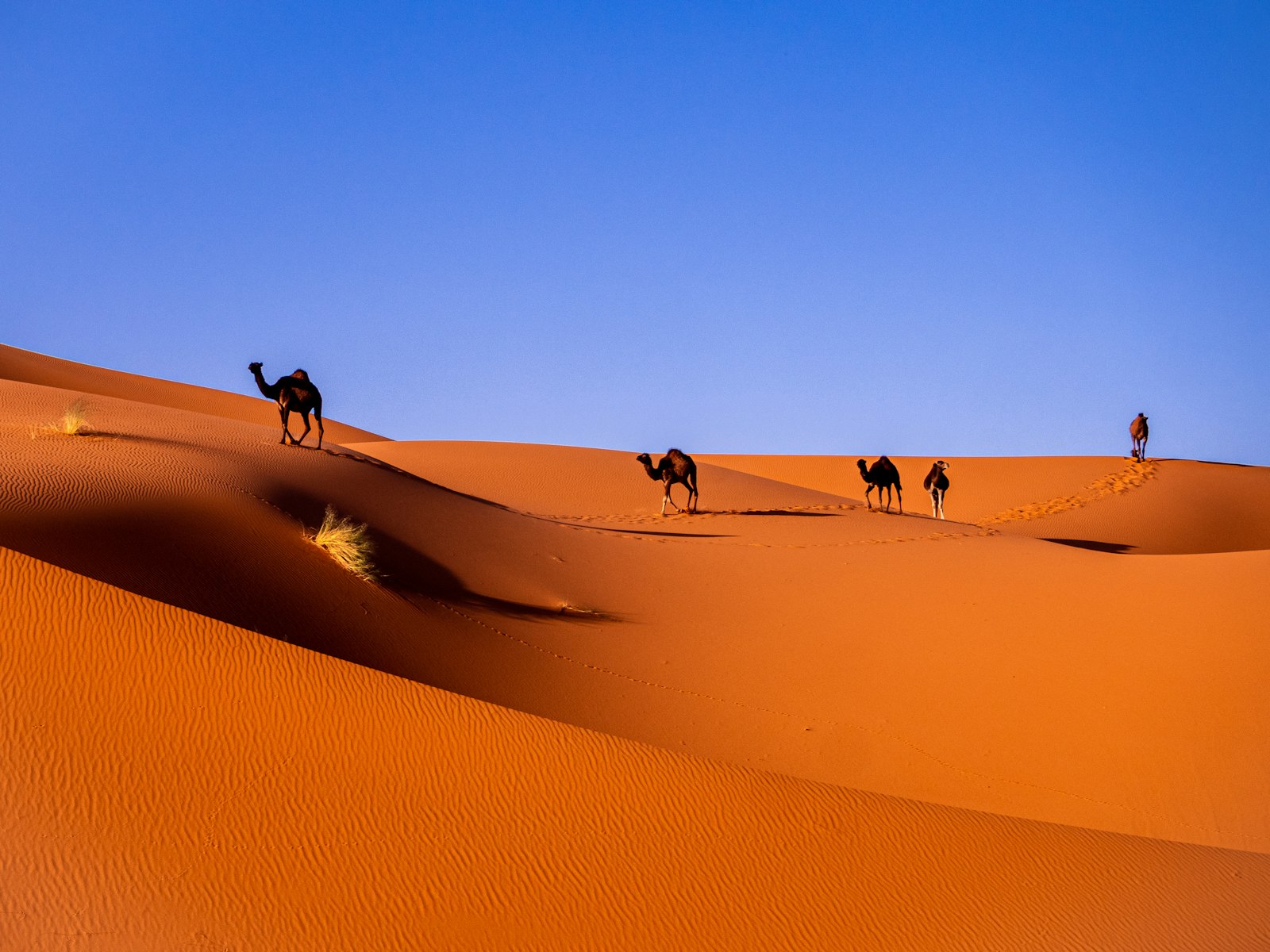
Every Morocco itinerary eventually faces the same question: which part of the Sahara Desert should I visit — Merzouga or Zagora? Both offer the quintessential Moroccan desert experience (camel rides, Berber bivouacs, spectacular dunes), but they are very different destinations that suit different types of travelers and different trip lengths. This guide breaks down exactly what each offers, so you can make the right call for your trip.
Merzouga vs Zagora: Quick Comparison
| Merzouga (Erg Chebbi) | Zagora (Erg Chigaga) | |
|---|---|---|
| Distance from Marrakech | 350 miles / 9–10 hours | 220 miles / 5–6 hours |
| Dune height | Up to 500 feet — among the tallest in Africa | Up to 300 feet — smaller but still impressive |
| Dune type | Classic orange-gold Saharan erg (sea of dunes) | More isolated, mixed terrain with rocky plains |
| Tourism level | More visited — better infrastructure | Less visited — more remote feel |
| Best for | First-time visitors, classic Sahara photos | Travelers on a shorter timeline, seeking solitude |
| Minimum trip needed | 3 days from Marrakech (1 night in desert) | 2 days from Marrakech (1 night in desert) |
| Price (bivouac) | $60–200/person/night | $50–150/person/night |
Merzouga and Erg Chebbi: The Classic Sahara
Merzouga is the desert most people picture when they think of Morocco. The Erg Chebbi dunes rise dramatically from flat rock desert — a wall of golden sand stretching 28 kilometers long and up to 5 kilometers wide. At sunrise and sunset, the dunes cycle through colors: steel grey, burning gold, deep orange, brick red. These are among the most photographed landscapes in all of Africa.
Why Choose Merzouga
- The dunes are exceptional. Erg Chebbi is genuinely one of the world’s great sand seas. If you want the classic Saharan experience — towering orange dunes, camel silhouettes at sunset, the full desert sky at night — Merzouga delivers it completely.
- More developed infrastructure. Merzouga has a wider range of desert camps from budget to ultra-luxury, more transportation options, and better access for travelers with limited mobility.
- The Ksar of Aït-Benhaddou is on the way. The spectacular Road of Kasbahs between Marrakech and Merzouga passes through some of Morocco’s most dramatic landscapes and UNESCO sites, making the journey part of the experience.
- It’s the standard itinerary. Most organized Morocco tours include Merzouga, making it easy to find group tours, shared transport, and a well-defined circuit.
What to Do in Merzouga
- Sunrise dune climb: Wake at 5:30am and climb the main dune (45–60 minutes to the top) before sunrise. The view at first light — looking out over an endless sea of dunes in complete silence — is the single most memorable experience most visitors report from their entire Morocco trip.
- Camel trek to the bivouac: The 1-hour camel ride to your desert camp at sunset is iconic. Most camps provide 4×4 transfers as an alternative if camels aren’t your thing.
- Sandboarding: Available at most camps. The steep dune faces are perfect for it.
- Visit a Gnawa village: The small village of Khamlia, 5 km from Merzouga, is home to a community of Gnawa musicians descended from sub-Saharan Africans. Visiting for a performance is a remarkable cultural experience.
- 4×4 desert excursion: Full-day tours take you deeper into the desert, to fossil beds, nomad tents, and the Algerian border areas.
Getting to Merzouga
From Marrakech: 350 miles via the N9 and N10 (Road of Kasbahs). Allow 9–10 hours driving with stops at Aït-Benhaddou, Ouarzazate, and the Dadès Gorges. Most travelers do this over 2 days, stopping overnight in the Dadès or Todra area. Organized tours from Marrakech run 2-day/1-night ($60–100/person) and 3-day/2-night options.
Zagora and Erg Chigaga: The Remote Option
Zagora is the jumping-off point for Erg Chigaga, a remote dune system 60 km further into the Sahara that sees far fewer tourists than Merzouga. The approach from Zagora is an adventure in itself — the last stretch requires a 4×4 through sandy pistes. The reward is a more isolated desert experience with very few other tourists around.
Why Choose Zagora
- Much closer to Marrakech. At 5–6 hours from Marrakech (vs 9–10 for Merzouga), Zagora is viable for travelers with only 8–9 days who still want the desert experience.
- Fewer tourists. Erg Chigaga is significantly less visited than Erg Chebbi. If solitude in the Sahara matters to you, Zagora delivers it better.
- The Draa Valley. The road from Marrakech to Zagora passes through the spectacular Draa Valley — Morocco’s longest river valley, lined with 1,500-year-old palm oases, mud-brick kasbahs, and Berber villages. This landscape alone justifies the detour.
- Authentic nomad encounters. The Zagora area has more active nomadic communities than the more tourist-developed Merzouga region.
Limitations of Zagora
- The dunes are impressive but not as dramatic as Erg Chebbi. If you have Instagram-worthy Sahara photos as a priority, Merzouga wins.
- Access to Erg Chigaga requires a 4×4 (2 hours from Zagora on piste). You cannot reach the main dunes by camel from Zagora town — a transfer is needed.
- Fewer infrastructure options for camps, especially at the luxury end.
Which Should You Choose?
| Your situation | Recommended choice |
|---|---|
| First trip to Morocco, 10+ days | Merzouga — the classic experience, fits the standard circuit |
| Only 8–9 days total, Marrakech-based | Zagora — much closer, viable without cutting other destinations |
| Want maximum solitude and remoteness | Zagora (Erg Chigaga) — far fewer tourists |
| Photography is a priority | Merzouga — the Erg Chebbi dunes are more dramatic and more photogenic |
| Traveling with a family with kids | Merzouga — more infrastructure, easier logistics |
| Luxury desert experience | Merzouga — more high-end camps to choose from |
| Budget travel, joining group tours | Merzouga — more group tour options, lower per-person costs |
| Want to see the Draa Valley palmeraie | Zagora — the Draa Valley route is spectacular |
Desert Bivouac: What to Expect
Whether you choose Merzouga or Zagora, the desert bivouac experience is broadly similar. You’ll sleep in a Berber-style tent (ranging from basic to fully equipped with en-suite bathroom at luxury camps), eat a traditional Moroccan dinner cooked over a fire, fall asleep to the sound of silence, and wake before dawn to watch the sunrise paint the dunes.
| Camp Type | Price/Person/Night | What’s Included |
|---|---|---|
| Budget camp | $40–70 | Basic tent, Moroccan dinner, breakfast, camel ride |
| Mid-range camp | $80–130 | Comfortable tent, private bathroom, dinner, music |
| Luxury camp | $150–350+ | En-suite tent/suite, gourmet dinner, private fire, transfers |
Practical Tips for Your Morocco Desert Trip
- Pack a light jacket. Sahara nights are surprisingly cold year-round — temperatures can drop to 40°F in winter and feel chilly even in spring and fall once the sun goes down.
- Bring a headlamp. Essential for navigating the camp at night and climbing dunes before dawn.
- Leave your phone in the tent sometimes. The night sky over the Sahara — completely unpolluted by artificial light — is something you want to experience with your eyes, not through a screen.
- Book your camp in advance. In October and April, good camps sell out weeks ahead. Don’t leave this to last-minute booking.
- Bring cash. No ATMs in the desert. Have enough MAD on hand for tips, any extras, and the camel handler.
- Wear closed shoes for the dune climb. Sand gets absolutely everywhere in flip flops or sandals.
Frequently Asked Questions
Is the Sahara Desert in Morocco worth visiting?
Absolutely — and most visitors describe the Sahara as the single most memorable part of their Morocco trip. Watching the sunrise from the top of a 500-foot dune, in complete silence, with an infinite sea of sand around you, is an experience unlike anything most Western travelers have ever had.
How many nights should I spend in the Sahara?
One night is the standard and is sufficient to have the full experience (sunset camel ride, Berber dinner, sunrise dune climb). Two nights allows for a more relaxed exploration and is worth it if you have the time. More than two nights is unusual — most travelers find one full day and two sunrises is the right amount.
What is the best time of year to visit the Sahara in Morocco?
October to April is ideal. Spring (March–May) and fall (September–November) offer comfortable temperatures — warm days, cool nights. Summer (June–August) is extremely hot (110°F+) — not recommended. Winter (December–February) is viable and sometimes beautiful with fewer tourists, but nights can be very cold (below freezing at altitude).
Can I visit the Sahara without a tour?
Yes, for Merzouga — you can drive yourself (or take a bus to Erfoud and a grand taxi to Merzouga), book your camp independently, and arrange camels directly. For Erg Chigaga near Zagora, a 4×4 and guide are effectively required for the last section — organizing through a local agency in Zagora is the easiest approach.